
The Training Paradox: Why Your Dog Isn’t Listening (And How to Fix It)
One sharp whistle. A distracted glance. A dog bolting toward a busy intersection while you scream a command they clearly know but choose to ignore. That is the nightmare every owner dreads. At My Pets Picks, we’ve spent twenty years deconstructing these moments of selective hearing. The sobering truth is that most dogs don’t fail because they are stubborn; they fail because the foundation of their dog training is built on a dialect the canine brain isn’t wired to process. Real success in dog training requires us to stop shouting and start communicating in a way they actually understand.
Effective dog training isn’t about dominance or parlor tricks. It is a biological negotiation. It requires aligning your intent with your dog’s neurological reward system. If you want a companion that responds with mechanical precision under pressure, you must move beyond the basic sit and stay mentality. This is about building a communication bridge designed to survive the chaos of the real world.
A dog already knows how to listen. The real work is teaching us how to speak clearly.
A dog already knows how to listen; the real challenge lies in teaching us how to speak. In our hands-on testing at My Pets Picks, we’ve uncovered a recurring pattern: dogs don’t struggle with learning—owners do. This isn’t due to a lack of care, but a lack of understanding regarding how a dog’s mind actually filters information.
If you’ve ever claimed, He knows this command, he’s just being stubborn, you are missing the internal mechanics at play. Dogs never ignore cues out of defiance. Their response—or lack thereof—hinges entirely on your clarity, timing, and the emotional safety of the bond.
Mastering dog training eliminates the distance between love and expertise. We’ve stripped away the gimmicks and dominance myths to give you a system grounded in behavior science and two decades of field experience. This is how you transform your pet from a reactive animal into a proactive, trusted partner.
The Neural Blueprint: How Dogs Actually Learn
Most manuals simplify instruction to a basic formula: say the word and give the treat. Honestly, that is a surface-level approach that collapses under real-world pressure. In our hands-on testing at My Pets Picks, we’ve identified that a dog’s learning curve isn’t driven by the treat itself, but by sensory enrichment and associative timing.
When you issue a command, you aren’t just making a sound; you are triggering a synaptic response in your pet’s brain. The window to solidify this connection is incredibly tight. If your reward arrives even 1.5 seconds late, the biological link breaks. You are no longer rewarding the Sit; you are accidentally reinforcing the ear flick or the tail wag that occurred afterward. This micro-second delay is where most dog training efforts fail before they even start.
The Science of the Synaptic Spark
To master dog training, you must act as an engineer of your dog’s dopamine levels. Every successful repetition carves a physical pathway in their brain, but this only happens when the marker (your reward or praise) is perfectly synchronized with the action.
We’ve seen it repeatedly: owners focus on the bribe rather than the bridge. Real progress occurs when the canine brain makes a lightning-fast connection between a specific movement and a positive outcome. If you cannot mark the behavior at the exact millisecond it happens, you are merely feeding your dog, not teaching them. Recognizing this distinction is the difference between a pet that listens occasionally and one that responds with instinctive, mechanical precision.
The Training Foundation Most People Skip
Before you attempt to teach a single command, you must establish three non-negotiable pillars. At My Pets Picks, we’ve observed that true dog training success isn’t about the quantity of hours spent; it’s about the structural integrity of the foundation. Without these, your efforts will likely result in confusion rather than cooperation.
1. Timing Beats Technique
A dog’s brain operates on a lightning-fast feedback loop. They connect cause and effect in seconds, not minutes. If you praise or correct your pet even thirty seconds after the action, the lesson evaporates. They cannot bridge the gap between their past behavior and your current reaction. To master dog training, you must capture the instant mark—recognizing the exact millisecond your dog makes the right choice.
2. Motivation: Beyond the Biscuit
While treats are a powerful tool, they aren’t the only currency in a dog’s world. High biological reward value varies wildly across different breeds and temperaments. For some, a quick game of tug or a sudden burst of movement is far more enticing than a piece of kibble. Identifying what truly drives your dog—whether it is play, novelty, or tactile praise—allows you to maintain their focus even in high-distraction environments.
3. Consistency Shapes the Brain
Neural pathways strengthen only through predictable, repeatable outcomes. If you allow a behavior today but discourage it tomorrow, the cognitive structure collapses. Dogs crave the security of a fixed rule set. When your responses remain consistent, the canine brain builds a permanent map of expected behaviors, eventually turning conscious effort into an instinctive habit.
Expert Behaviorist Insight: Always terminate your sessions while your dog is still at peak excitement. Stopping before they reach the point of boredom or mental fatigue leaves them in a state of high curiosity. This cliffhanger effect ensures they are twice as eager to participate in the next session.
Understanding Your Dog Before Training
Before you apply a single technique, you must look at the animal in front of you. Most owners fail because they attempt to force a one-size-fits-all method onto a living creature with unique genetic predispositions. At My Pets Picks, we’ve learned that successful dog training begins with a deep audit of your dog’s age, breed, and temperament.
The Lifecycle Shift: Puppies vs. Adult Dogs
Age dictates the rhythm of learning. Puppies possess incredible cognitive plasticity—they are blank slates ready to absorb everything. However, their neurological development limits their focus. If you push beyond a five-to-ten-minute window, you aren’t teaching; you’re merely exhausting a developing brain.
Adult dogs, conversely, often carry the ghosts of past behaviors. While they may take longer to unlearn a deeply ingrained habit, their ability to sustain focus is vastly superior to a puppy’s. The strategy here shifts from rapid-fire exposure to intentional re-patterning.
Genetic Hardwiring: The Breed Factor
Every breed enters the world with a specific operating system. Ignoring this genetic reality is the fastest way to hit a wall in your dog training journey:
- The Intellectual Athletes (e.g., Border Collies): These dogs don’t just want to learn; they need to work. They process commands with lightning speed but will find their own (often destructive) jobs if you don’t keep them mentally challenged.
- The Deliberate Thinkers (e.g., Bulldogs): Often mislabeled as stubborn, these breeds simply process data differently. They require more repetition and a very high return on investment before committing to a command.
- The Eager Cooperators (e.g., Labradors): Highly food-motivated and genetically tuned to human emotion, these dogs are excellent candidates for positive reinforcement, provided you manage their caloric intake to avoid obesity.
Temperament: The Individual X-Factor
Beyond breed, you must assess the individual. Is your dog shy, reactive, or perhaps overly energetic? A shy dog needs confidence-building exercises before they can handle the pressure of a Stay command. An energetic dog might need a physical outlet—like five minutes of high-intensity fetch—to burn off excess noise before their brain is ready to settle. Tailoring your approach to these nuances isn’t just a kindness; it’s a tactical necessity for long-term behavioral success.
The Tactical Gear: Essential Tools for Effective Dog Training
Successful training occurs when you eliminate luck and start using the right equipment. Most owners fail because they bring low-value energy to a high-stakes learning environment. At My Pets Picks, we’ve tested hundreds of products, and the reality is that you don’t need a garage full of gadgets. You need a specific, high-quality kit that removes the mechanical friction between you and your dog.
The Professional’s Equipment Checklist
Before you begin, audit your gear. If your leash is too heavy or your treats are too dry, you are already fighting an uphill dog training battle.
- A Reliable Lead: A standard 6-foot leather or bio thane leash. Retractable leashes are a nightmare for precision; they inadvertently teach dogs that pulling creates more freedom.
- The Comfort Foundation: Use a well-fitted flat collar or a Y-shaped front-clip harness. Avoid any equipment that causes pain, as fear creates a neurological block that halts the learning process.
- The Clicker (The Event Marker): This small tool is incredibly powerful. It tells the dog exactly which millisecond they earned the reward, providing much-needed clarity.
- A Quiet Lab Environment: Initially, your training space must be a sensory vacuum. Eliminate squirrels, traffic, and household chaos to ensure your dog’s brain can focus.
Mastering the Reward Hierarchy
Not all treats carry the same weight. If you try to teach a complex behavior using boring kibble, your dog will likely lose interest. To master dog training, you must build a Reward Hierarchy based on your dog’s specific biological currency.
| Reward Level | The Currency | Tactical Use Case |
| Low Value | Standard Kibble | Reinforcing known commands in a quiet house. |
| Medium Value | Soft, smelly commercial treats | Learning new movements with minor distractions. |
| High Value | Tiny pieces of boiled chicken or liver | The Jackpot for difficult recalls or high-stress environments. |
The Power of Positive Reinforcement
Positive reinforcement serves as the engine for learning how to teach basic commands to dogs step by step. However, it only functions if your timing is flawless. You must deliver the reward immediately after the correct behavior—ideally within 0.5 to 1.5 seconds. If you fumble with your treat bag, your dog will forget what they are being paid for. Efficiency is the key to psychological clarity.
How to Teach Basic Commands to Dogs Step by Step
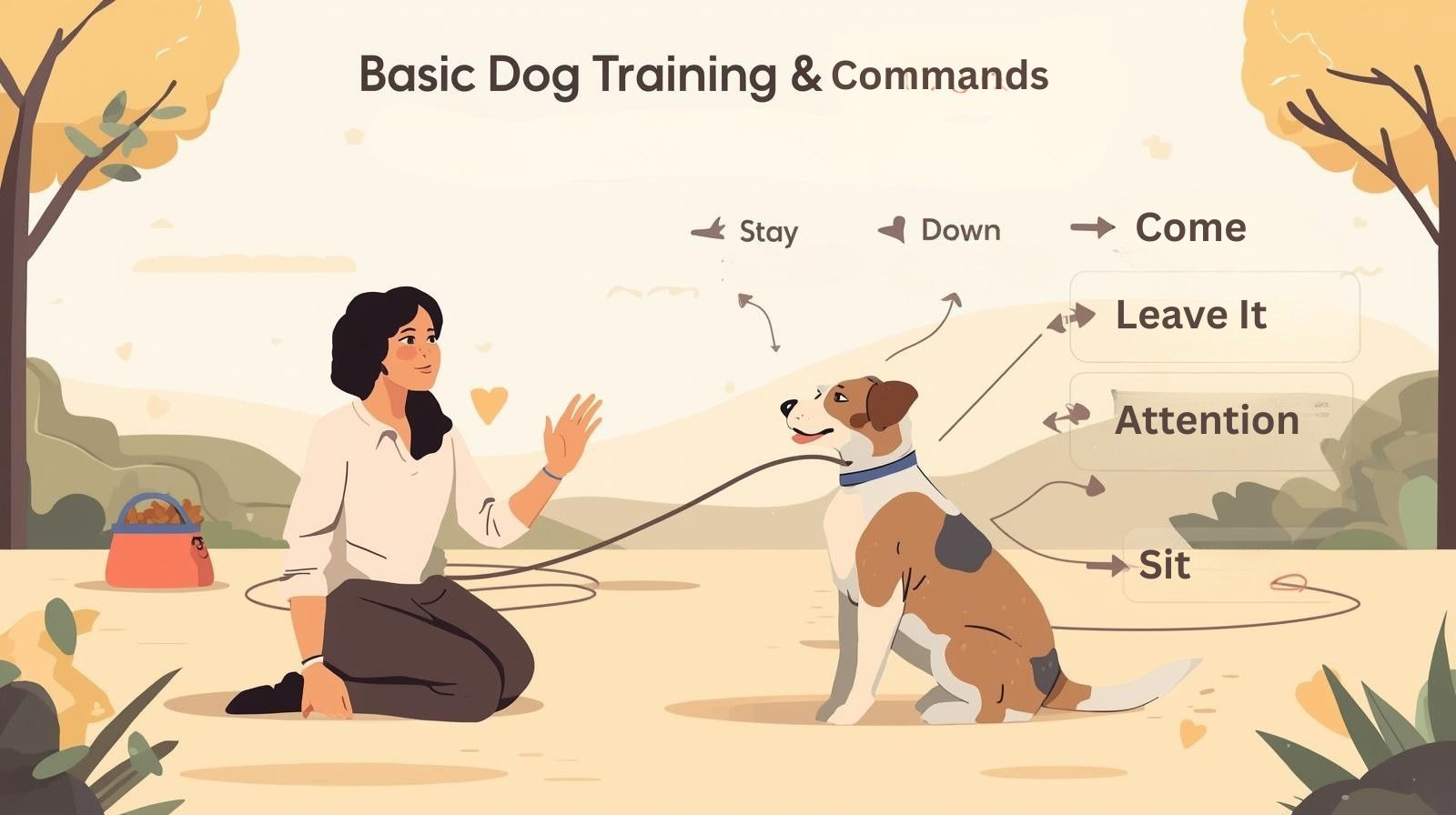
Now we’ll break down the core commands every dog should know.
Command 1: Sit
- Hold a treat near your dog’s nose.
- Slowly move it upward.
- As the head follows, the bottom lowers.
- Say Sit.
- Reward immediately.
Repeat 5–7 times per session.
Command 2: Stay
- Ask your dog to sit.
- Open your palm and say Stay.
- Take one step back.
- Return and reward.
Gradually increase distance and duration.
Command 3: Come
Recall saves lives.
- Attach a leash.
- Say your dog’s name + Come.
- Gently pull if needed.
- Reward enthusiastically.
Never punish after they come—even if they were misbehaving.
Command 4: Down
- Start from sit.
- Lower a treat to the ground.
- Slide it forward.
- When elbows touch ground, say Down.
- Reward.
Command 5: Leave It
- Place treat in closed fist.
- Let dog sniff.
- Say Leave it.
- When they stop trying, reward from other hand.
Impulse control builds safety and trust.
By following these techniques consistently, you’ll master how to teach basic commands to dogs’ step by step effectively and humanely.
Common Mistakes and How to Avoid Them
Even experienced owners make errors. Here’s what to watch for:
- Inconsistency in commands
- Long training sessions
- Delayed rewards
- Repeating commands excessively
- Training when frustrated
FAQs: Expert Tactical Insights
1. My dog is food-motivated at home but ignores me outside. Why?
This is a Threshold issue. The environment’s sensory enrichment (smells, squirrels, cars) is currently worth more than your treat. You need to increase the value of your reward or decrease the distance from the distraction.
2. Can I train an older dog?
Absolutely. While the microbiome of a puppy’s brain is more plastic, older dogs often have better focus. The process remains the same, though you may need to account for physical limitations like arthritis when asking for a Down.
3. How long should training sessions be?
Stop before the dog gets tired. For most, 5 to 10 minutes of high-intensity work is better than 30 minutes of bored repetition. We’ve found that two mini-sessions a day produce significantly faster results.
4. What is the most common training mistake?
Repeating the command. If you say Sit, Sit, Sit, the dog learns that Sit means Wait for my owner to say it three times. Say it once. If they don’t do it, reset the dog and try again.
The Lifelong Commitment to Protection
True training is the silent language of love. It is the invisible infrastructure you build every time you reward a focus glance or a calm sit. Your pet lives in a world engineered for human convenience, and they rely entirely on your expertise to navigate its hidden mechanical and chemical traps.
By applying these strategies, you transition from a reactive owner to a proactive guardian. Safety forms the bedrock of the bond you share; it is the gift of a long, vibrant life, free from preventable trauma. At My Pets Picks, we believe that when you master the environment and the communication, you truly master the art of ownership.