
Finding the right financial solution when managing multiple high-interest debts can be overwhelming. Whether you are dealing with compounding credit card balances, high-APR medical bills, or unexpected personal expenses, choosing between high-paying personal loans and structured debt consolidation options is one of the most critical financial decisions you will make.
In today’s US financial market, personal loan rates and debt consolidation programs vary significantly depending on your credit score, debt-to-income (DTI) ratio, lender requirements, and repayment terms. While some borrowers benefit from fixed-rate unsecured personal loans, others find relief through balance transfer credit cards, home equity loans, or specialized debt management plans.
This comprehensive 2026 guide breaks down the best high-paying personal loans, top-rated debt consolidation lenders, key approval criteria, interest rate comparisons, and actionable strategies to lower your monthly payments while protecting your credit score.
Understanding Personal Loans vs. Debt Consolidation
Before applying for any credit product, it is essential to understand how personal loans and debt consolidation mechanisms work, as well as how lenders structure their offerings.
What Is a Personal Loan?
A personal loan is an unsecured or secured installment loan provided by online lenders, traditional commercial banks, or credit unions. Borrowers receive a lump sum upfront and repay the principal plus interest in fixed monthly installments over a set timeframe (typically 1 to 7 years). Because most personal loans are unsecured, lenders do not require physical collateral such as a home or vehicle; instead, approval depends heavily on your credit profile and verified income.
What Is Debt Consolidation?
Debt consolidation is the strategic process of combining multiple existing high-interest debts—such as credit card balances, store cards, and payday loans—into a single, unified monthly payment. This is usually achieved by taking out a low-APR consolidation loan or transferring balances to a 0% APR intro card. The primary objective is to secure a lower overall interest rate, simplify budgeting, and pay off debt faster.
Why Debt Consolidation Is Essential for High-Interest Debt
Carrying balances across multiple credit cards often exposes consumers to variable APRs exceeding 22% to 29%. When interest compounds daily, a substantial portion of your monthly payment goes toward financing charges rather than reducing the actual principal.
Key Benefits of Consolidating Debt:
- Single Monthly Payment: Eliminates the hassle of tracking multiple due dates, reducing the risk of missed payments and late fees.
- Fixed Interest Rates: Replacing variable credit card APRs with a fixed-rate personal loan protects you from rising market interest rates.
- Structured Payoff Timeline: Consolidation loans feature clear payoff dates (e.g., 36 or 60 months), unlike revolving credit card minimum payments that can drag on for decades.
- Boost to Credit Utilization: Paying off revolving credit card balances with an installment loan dramatically reduces your credit utilization ratio—a major factor in calculating your FICO score.
Top High-Paying Personal Loan Lenders in the US
When evaluating personal loan providers for large borrowing amounts (up to $50,000 or $100,000), lenders differ in origination fees, interest rate ranges, credit requirements, and funding speed. Below are the top-rated lenders operating in the United States.
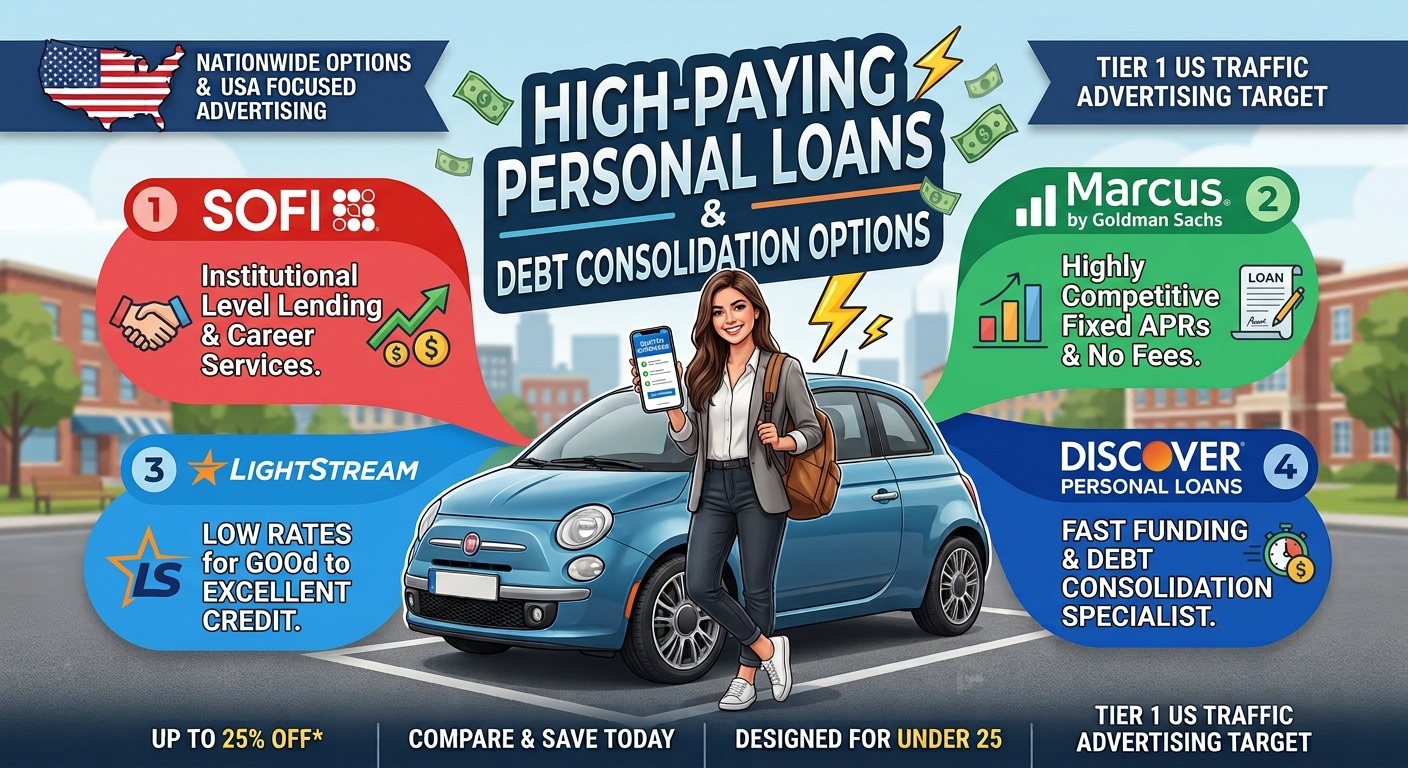
1. SoFi: Best for High Loan Limits & Excellent Credit
SoFi is a leading online lender offering personal loans up to $100,000 with competitive APRs. SoFi stands out by offering no required fees, flexible payment terms, and direct creditor payoff options for debt consolidation borrowers.
- Pros: Same-day funding potential, no origination or late fees, unemployment protection benefits.
- Cons: Strict income and high credit score requirements.
2. Marcus by Goldman Sachs: Best for No-Fee Debt Consolidation
Marcus provides streamlined, fixed-rate personal loans with zero fees—meaning no origination fees, late fees, or prepayment penalties. They also offer direct payment to up to 10 creditors, making debt consolidation effortless.
- Pros: Completely fee-free, customizable monthly payment dates, direct creditor payoff.
- Cons: No soft-pull joint application options, loan amounts capped at $40,000.
3. Light Stream: Best for Low Rates on Large Unsecured Loans
Light Stream (a consumer lending division of Truist Bank) is tailored toward borrowers with strong credit histories. They offer high loan limits up to $100,000 and back their competitive rates with a “Rate Bump” discount for setting up AutoPay.
- Pros: Extremely low APR floors, long repayment terms available, no fees.
- Cons: No soft-pull pre-qualification on their main application; requires solid credit history.
4. Upstart: Best for Fair Credit & Alternative Underwriting
Upstart uses AI-driven underwriting models that consider factors beyond traditional FICO scores, such as education, employment history, and work experience. This makes Upstart an excellent option for younger borrowers or those rebuilding credit.
- Pros: High approval rates for fair credit, fast next-day funding.
- Cons: Higher origination fees (up to 12%), higher APR ceiling for lower-tier credit.
Best Debt Consolidation Options Compared
While an unsecured personal loan is the most popular route, several alternative debt consolidation methods exist. Selecting the optimal method depends on your credit standing, home equity, and risk tolerance.
Option A: 0% APR Balance Transfer Credit Cards
If your total high-interest debt is manageable (e.g., under $15,000) and you have a strong credit score (670+), a balance transfer credit card offers a zero-interest promotional window lasting anywhere from 12 to 21 months.
- How It Works: You move balances from existing high-APR credit cards to a new card offering 0% APR on balance transfers.
- Key Caution: Cards usually charge an upfront balance transfer fee of 3% to 5%. Furthermore, if you fail to pay off the balance before the promotional window expires, the remaining balance will be subject to standard variable credit card rates (often 20%+).
Option B: Home Equity Loans & HELOCs
Homeowners holding significant property equity can secure lower interest rates by utilizing a Home Equity Loan or Home Equity Line of Credit (HELOC).
- Why Rates Are Lower: Because these loans are secured by your residence, lenders face less risk and can offer significantly lower interest rates than unsecured loans.
- Critical Risk: Your home serves as collateral. Failing to meet monthly repayment obligations can result in foreclosure.
Option C: Non-Profit Debt Management Plans (DMPs)
For borrowers struggling with low credit scores who cannot qualify for a low-interest personal loan, non-profit credit counseling agencies offer Debt Management Plans.
- How It Works: A certified credit counselor negotiates directly with your credit card issuers to reduce interest rates, waive late fees, and establish a single monthly payment over 3 to 5 years.
- Impact: Your credit card accounts will usually be closed, which temporarily lowers your score, but provides a sustainable path out of severe debt.
How Lenders Calculate Your Interest Rate (APR)
When you apply for a high-paying personal loan or debt consolidation offer, financial institutions do not offer arbitrary rates. Instead, automated underwriting engines calculate your risk profile using specific metrics
1. FICO Credit Score Ranges
- 720 – 850 (Excellent): Qualifies for single-digit APRs (e.g., 6.99% – 10.99%) with zero origination fees.
- 660 – 719 (Good): Qualifies for competitive rates (11% – 18%).
- 580 – 659 (Fair): Qualifies for moderate-to-high rates (19% – 28%); origination fees are common.
- Below 580 (Poor): High risk; requires specialized bad-credit lenders, co-signers, or collateral.
2. Debt-to-Income (DTI) Ratio
Lenders calculate your DTI by dividing your total monthly debt obligations (rent, mortgages, existing credit cards, auto loans) by your gross monthly income.
- A DTI ratio below 36% is preferred by major financial institutions.
- A DTI ratio above 45% indicates financial strain, leading to higher interest charges or outright rejection.
Step-by-Step Guide to Applying for a Debt Consolidation Loan
To secure the lowest interest rates and avoid predatory lenders, follow this structured application protocol:
Step 1: Audit Your Current Debt
List all outstanding debts along with their balances, current APRs, and minimum monthly payments. Calculate your total payout amount to determine the exact loan size required.
Step 2: Check Your Credit Score & Pre-Qualify
Review your credit reports from Equifax, Experian, and TransUnion for inaccuracies. Utilize online pre-qualification tools provided by reputable lenders to view estimated rates via soft credit inquiries (which do not impact your credit score).
Step 3: Compare APRs, Fees, and Total Cost
Do not look solely at the monthly payment figure. Compare the Total Cost of Credit, including:
- Fixed vs. Variable Interest Rates
- Origination Fees (subtracted from loan proceeds)
- Prepayment Penalties (choose lenders with $0 prepayment penalty)
Step 4: Submit Formal Application & Verify Income
Once you select the best lender, submit a formal application. Prepare income verification documents such as recent W-2s, tax returns, pay stubs, and bank statements.
Step 5: Pay Off Creditors Directly
Upon loan approval, send funds directly to your old credit accounts. Many debt consolidation lenders offer automatic direct payoff services, ensuring funds are properly allocated without passing through your checking account.
Hidden Fees and Pitfalls to Avoid
Navigating personal financial products requires caution regarding hidden costs and high-risk lending practices.
- Origination Fees: Charged by lenders to process applications, ranging from 1% to 12% of the total loan amount. Always account for this fee when determining how much to borrow.
- Prepayment Penalties: Fees assessed if you pay off your loan early. Avoid lenders that penalize early repayment.
- The “Fresh Credit” Trap: The biggest mistake borrowers make after consolidating credit card debt with a personal loan is using those newly freed credit cards again. Running up new card balances alongside your consolidation loan leads to compounding debt.
- Predatory Payday Consolidation: Avoid lenders promising “guaranteed approval” without income checks, as these often involve predatory APRs exceeding 100%.
Important Regulatory and Financial Compliance Notes
Personal loans and debt consolidation mechanisms operating within the United States are regulated under federal and state financial consumer protection laws:
- Truth in Lending Act (TILA): Enforced by the Consumer Financial Protection Bureau (CFPB), TILA requires lenders to clearly disclose the Annual Percentage Rate (APR), total finance charges, payment schedule, and loan terms prior to contract execution.
- State Usury Caps: Individual US states maintain interest rate caps governing unsecured consumer lending. Maximum allowable APRs vary depending on state jurisdiction and lender chartering.
- Credit Bureau Reporting: Lenders periodically report repayment activities to major consumer reporting agencies (Experian, TransUnion, Equifax). Timely payments positively affect your payment history, while defaults or delinquencies result in score reductions.
Frequently Asked Questions (FAQs)
Will applying for a personal loan affect my credit score?
Pre-qualifying uses a soft credit check, which has no effect on your credit score. When you formally apply, the lender performs a hard credit inquiry, which may temporarily reduce your score by 3 to 5 points. However, successfully consolidating revolving debt usually improves your score over time.
Can I get a debt consolidation loan with bad credit?
Yes, but loans for borrowers with fair or bad credit (under 620) come with higher APRs and origination fees. Alternatively, applying with a creditworthy co-signer or seeking assistance through a non-profit credit counseling service can help lower costs.
What is the difference between debt consolidation and debt settlement?
Debt consolidation pays off your debt in full using a new low-interest loan or structured plan without harming your credit history. Debt settlement involves negotiating with creditors to pay less than what you owe, which typically requires defaulting on payments first and leaves severe, long-lasting damage on your credit report.
Conclusion: Taking Control of Your Financial Future
Securing a high-paying personal loan or debt consolidation option is a proven strategy to streamline high-interest debt, lower interest charges, and accelerate your journey toward financial freedom. By comparing pre-qualification rates across top US lenders, understanding origination fees, maintaining disciplined spending habits, and selecting terms matched to your budget, you can eliminate debt efficiently and effectively.
Before committing to any loan contract, evaluate your budget, review lender disclosures carefully, and ensure your monthly payments fit comfortably within your financial plan.